We cannot overstate the importance of calculating the ROI of customer experience: how can you build, measure, and continually optimize your CX efforts if you do not know the return on your investment?
Customer experience leaders often run into budget approval obstacles because the ROI of CX has not been quantified. All the time and effort invested in designing a modern, responsive customer experience program can be wasted if you are unable to express its value to your organization in numbers.
In this article, we walk you through calculating the ROI of your customer experience step by step, and how to use that ROI to build a successful CX program.
The ROI Imperative
You will not get executive buy-in, budget approval, the ability to communicate success, or career advancement if you cannot estimate and then validate the return on investment of your actions. Customer experience is no exception — even though it remains difficult to measure quantitatively.
Metrics such as NPS have become commonplace, blindly accepted by many, but CX professionals still struggle to get companies to act on what actually moves these metrics.
There are three main reasons why proving CX ROI is difficult:
- Speed and accuracy of data — having concrete data rather than anecdotes remains a challenge for many CX professionals.
- CX is perceived as a fuzzy, unquantified, and therefore unreliable concept.
- People do not truly understand the revenue impact of even a small NPS improvement.
Why Is CX ROI Difficult to Calculate?
ROI is easy to calculate for any investment whose results are immediate. Established businesses know the value of a lead because they know how leads convert into customers — making ROI straightforward to compute.
When it comes to seeing improvements from CX investments, it can take months or even years to see results:
- 1. Measure CX using a metric like NPS and identify its drivers.
- 2. Implement improvements.
- 3. Wait for customers to notice the improvements.
- 4. Measure again and assess the change in behavior.
How to Calculate the Benefits of CX Investments
#1 Identify the Business Metrics Most Impacted by Customer Experience
Investing in customer experience is critically important today and delivers several quantifiable benefits. The key is to choose the business metrics that best fit your industry and your company.
Revenue
Revenue is the most common metric to consider. A recent Forrester study revealed that CX leaders outperformed CX laggards by a ratio of 5 to 1 in revenue growth.
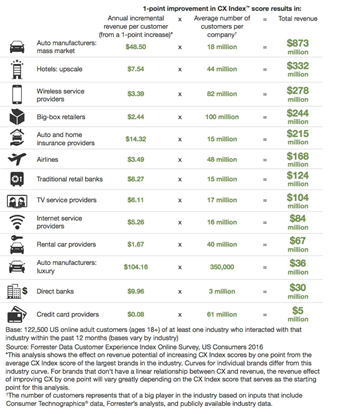
Source: Forrester
Retention
Improving customer experience has a direct impact on increasing customer retention and reducing churn. Given how easy it is to switch providers, most customers are quick to turn to a competitor after a poor experience. Conversely, they reward great experiences with continued loyalty.
According to Forrester, customers who have a high-quality experience are 2.7 times more likely to stay with a brand long-term than customers who have a low-quality experience.
Upsell & Cross-sell
Customers who are delighted with their experience spend more — buying additional products and services. They enjoy interacting with your business and come back regularly.
Customer Satisfaction
Measuring the revenue impact of an increase in customer satisfaction is the hardest part of calculating CX ROI. Companies tend to view customer satisfaction as a warm, fuzzy concept that is difficult to pin down quantitatively. But the revenue impact of customer satisfaction can and should be measured.
#2 Use Customer Journey Analytics to Show the Link Between Business Metrics and CX
Choosing the right business metrics and calculating their quantitative impact is a crucial — and difficult — first step.
To prove this correlation definitively, you need to use customer journey analytics.
Identify the Factors That Influence Customer Behavior
To demonstrate the link between CX metrics and customer experience, you must first discover how the customer experience drives changes in customer behavior. Customer journey analytics solutions like AFS Analytics can do this.
Segment Your Customer Database
Not all customers are equal. Some generate far higher revenue, while others may be strategically important. It is essential to identify these high-value customers and focus your CX investments and efforts on them.
Discover the Impact of CX on Business Metrics
Using customer journey analytics, you can discover how your customers interact with your business, how their behavior changes based on their experience, and how your business metrics are ultimately affected by those behavioral shifts.

Source: Forrester
Conclusion
Customer experience ROI is not just a nice-to-have — it is the foundation for making smart CX investments. By linking the right business metrics to customer journey data, you can build a compelling business case, secure executive support, and continuously improve the experiences that drive loyalty and revenue.